


60 Min vs 90 Min vs 120 Min Fire Rated Doors: Key Differences
2026-03-08 14:46Fire Rated Door Technical Guide
60 Min vs 90 Min vs 120 Min Fire Rated Doors: Key Differences
Fire rated doors are commonly selected by fire resistance time, such as 60 minutes, 90 minutes, or 120 minutes. However, the right choice is not only about choosing the highest rating. Buyers also need to consider building application, fire zone requirement, door structure, hardware configuration, wall condition, project budget, installation environment, and long-term maintenance. Understanding the differences between 60 min, 90 min, and 120 min fire rated doors helps project owners, contractors, and distributors select a safer and more suitable door solution.
Fire rating time refers to how long a fire rated door system is designed to resist fire under specific test conditions. A 60 minute fire rated door, 90 minute fire rated door, and 120 minute fire rated door represent different levels of fire resistance performance. In commercial buildings, this rating helps slow the spread of fire and smoke, protect escape routes, and divide the building into safer fire zones. However, buyers should not treat fire rating as the only selection standard. A fire rated door is a complete system, including door leaf, frame, core material, hinges, lock, closer, seals, and optional hardware. If the door leaf has a high fire rating but the frame, hardware, or installation conditions are not suitable, the overall performance may still be affected. In real projects, 60 min doors are often used in general fire separation areas, 90 min doors are commonly used in higher-risk commercial areas, and 120 min doors are usually selected for more demanding zones such as equipment rooms, special fire partitions, industrial buildings, or areas with stricter fire protection requirements. Suitable for many general commercial fire separation areas, interior corridors, office zones, and standard building applications where moderate fire resistance is required. A common choice for commercial buildings, apartment projects, stairwells, public access areas, and locations requiring stronger fire protection performance. Often selected for higher-risk areas, equipment rooms, warehouses, factories, fire compartments, and projects with stricter safety requirements. The most obvious difference is the fire resistance time, but the practical differences often include door structure, material selection, thickness, core design, frame strength, sealing system, and hardware requirements. As the fire rating increases, the door usually requires stronger structural design and better matching between the door leaf and frame. A 60 minute fire rated door may be suitable for standard interior separation in many commercial environments. A 90 minute fire rated steel door is often preferred when the project requires a higher level of fire protection but still needs reasonable cost control. A 120 minute fire rated door is usually selected when the fire risk is higher or when the building design requires longer protection time. Buyers should also consider usage frequency. For high-traffic areas such as stairwells, emergency exits, hospital corridors, school buildings, shopping malls, and public facilities, hardware quality becomes very important. Hinges, closers, locks, panic bars, and coordinators must be selected according to both fire performance and daily operation. The correct fire rating should be selected according to the building design, fire compartment plan, local project requirement, and application area. Buyers should avoid choosing a door only because it is cheaper, but they also do not always need the highest rating for every opening. The right selection should balance safety, project requirement, budget, installation conditions, and long-term use. For office buildings, hotels, apartments, schools, and hospitals, 90 minute fire rated steel doors are often a practical choice for important access areas, stairwells, corridors, and public zones. For factories, warehouses, equipment rooms, and special fire separation areas, 120 minute fire rated doors may be more suitable. For standard interior fire separation areas, 60 minute doors may be enough depending on the project requirement. The safest way is to send the door schedule, drawings, fire rating requirement, wall thickness, opening size, quantity, hardware list, and project location to the manufacturer. A professional fire rated door manufacturer can help check whether the selected fire rating, frame type, hardware, and packaging solution are suitable for the project. The key difference between 60 min, 90 min, and 120 min fire rated doors is not only the fire resistance time. It also affects door structure, hardware configuration, project cost, application area, and installation requirements. A 60 min fire rated door may be suitable for standard fire separation, a 90 min fire rated door is often suitable for many commercial building projects, and a 120 min fire rated door is better for stricter or higher-risk areas. If you are not sure which fire rating is suitable for your commercial building, apartment, hotel, factory, warehouse, hospital, school, or public facility project, send us your door schedule and project requirement. JIAHUI can help you review the configuration and provide a suitable fire rated steel door solution. For procurement comparison and technical evaluation, readers can continue with these related product pages and supporting articles. Send your fire rating requirement, door size, quantity, frame type, hardware list and project location. Our team will help you confirm the right fire rated door configuration.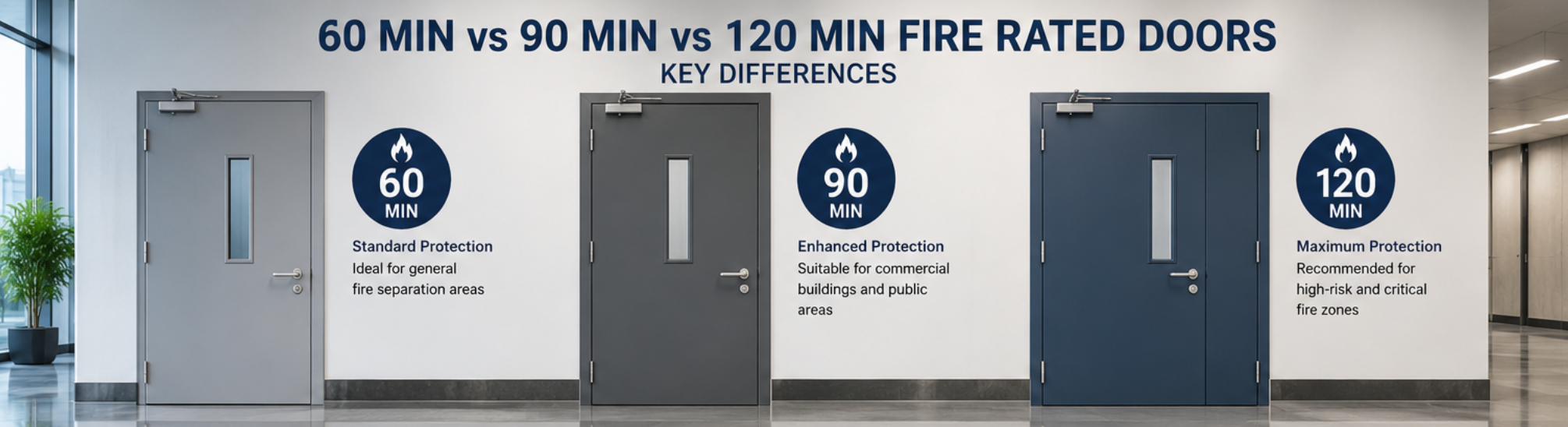
1. What Does Fire Rating Time Mean?
60 Min Fire Rated Doors
90 Min Fire Rated Doors
120 Min Fire Rated Doors
2. Main Differences Between 60, 90 And 120 Minute Fire Rated Doors

Comparison Table: 60 Min vs 90 Min vs 120 Min Fire Rated Doors
Item 60 Min Fire Rated Door 90 Min Fire Rated Door 120 Min Fire Rated Door Fire Resistance Level Standard protection for many general areas Higher protection for commercial and public areas Strong protection for demanding fire zones Typical Application Office rooms, corridors, standard interior areas Stairwells, apartments, hotels, public facilities Equipment rooms, warehouses, factories, fire partitions Door Structure Standard steel structure and fire resistant core Enhanced door leaf, frame and sealing design Stronger structure and higher fire resistance configuration Hardware Requirement Basic matched fire door hardware Reliable closer, hinges, lock and exit hardware Heavy-duty hardware for higher safety and durability Project Cost Usually more economical Balanced between performance and cost Usually higher due to stronger configuration Best For General fire separation Commercial project use High-risk or stricter fire zones 3. How To Choose The Right Fire Rating For Your Project

What Information Is Needed Before Quotation?
Conclusion: Choose Fire Rating Based On Real Building Needs
Need Help Choosing 60, 90 Or 120 Minute Fire Rated Doors?
Related product and article resources