


Common Mistakes When Buying Fire Rated Doors From China
2026-04-09 15:12Fire Rated Door Buying Guide
Common Mistakes When Buying Fire Rated Doors From China
Buying fire rated doors from China can be a practical choice for commercial buildings, hotels, apartments, hospitals, schools, factories, warehouses and public facility projects. However, many project problems happen because buyers only compare price and ignore important details such as fire rating, door size, frame type, opening direction, hardware, surface finish, packaging and project drawings. Understanding these common mistakes helps reduce wrong specifications, installation delays, extra costs and delivery risks.
1. Choosing Only By Price Without Checking Specifications
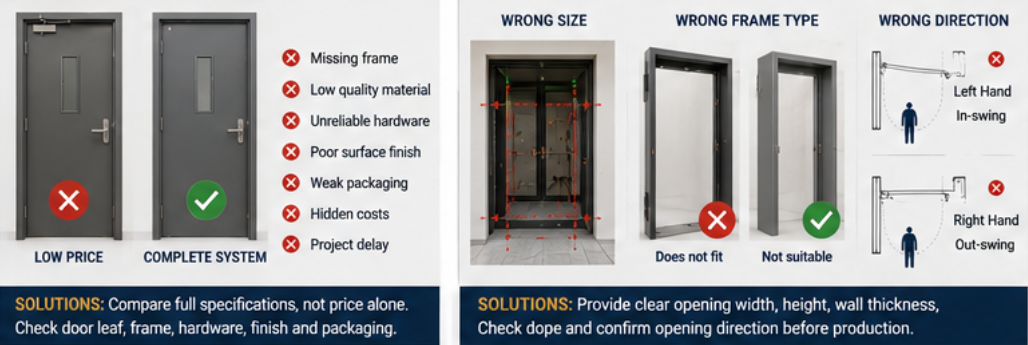
One of the most common mistakes is comparing fire rated doors only by unit price. A lower price may look attractive at the beginning, but it may not include the same fire rating, frame type, steel thickness, hardware configuration, surface finish, packaging method or customization details. If buyers compare prices without checking the full specification, the final product may not match the project requirement.
Fire rated doors should be evaluated as a complete door system. The door leaf, frame, hinges, lock, closer, seals, panic bar, vision panel and surface coating all affect the final cost and performance. A quotation that only includes a basic door leaf cannot be compared directly with a quotation that includes frame, hardware and export packaging.
Before confirming an order, buyers should ask for a clear specification sheet. It should include fire rating, door structure, frame design, hardware list, surface finish, size range, packaging and delivery terms. This makes price comparison more accurate and reduces hidden project risks.
Price Only
Low price may exclude frame, hardware, finish or export packaging.
Unclear Rating
Fire rating must match the real building zone requirement.
Wrong Size
Incorrect opening size can cause frame mismatch and site delays.
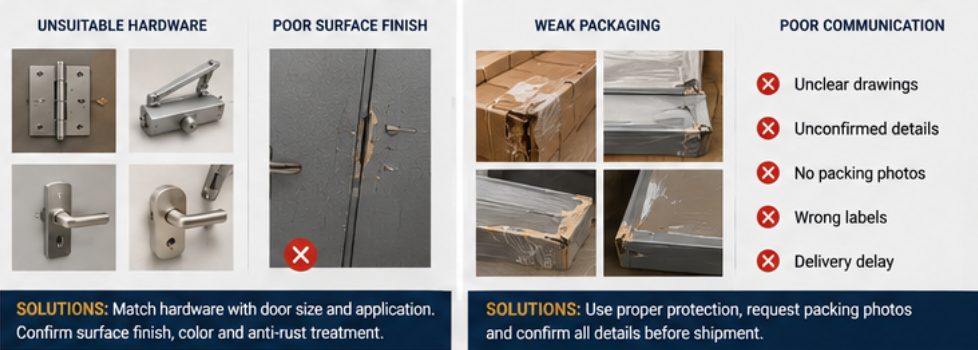
Weak Packaging
Poor packaging may cause scratches, deformation or surface damage.
2. Not Confirming Door Size, Frame Type And Opening Direction
Another common mistake is sending only a rough door size. Fire rated door production requires accurate opening width, opening height, wall thickness, frame requirement and installation tolerance. If these details are not confirmed before production, the door may not fit the site opening correctly.
Frame type should be confirmed early. Some projects may require welded frames, while others may prefer knock-down frames for easier packing and site assembly. The right frame design depends on the wall structure, project location, installation method and shipping requirement.
Opening direction is also easy to overlook. Buyers should confirm left hand, right hand, inward opening, outward opening, single leaf, double leaf or unequal leaf design. If the opening direction is wrong, hinge position, lock position and panic hardware layout may all be affected.
Mistake Checklist And How To Avoid Them
| Common Mistake | Possible Problem | How To Avoid It |
|---|---|---|
| Only comparing unit price | Different quotes may include different materials, hardware or packaging | Compare full specifications, not price alone |
| Unclear fire rating | Door may not match the fire zone requirement | Confirm 60 min, 90 min, 120 min or project-specific rating |
| Wrong opening size | Frame mismatch and installation delay | Provide width, height, wall thickness and tolerance |
| Ignoring opening direction | Wrong hinge, lock or panic bar position | Confirm left hand, right hand, inward or outward opening |
| Using unsuitable hardware | Poor closing, frequent maintenance or unsafe operation | Match hardware with door size, weight and application area |
| Not checking surface finish | Color difference, scratches or poor appearance after installation | Confirm coating, color, texture and sample before mass production |
| Weak export packaging | Door leaf, frame or surface may be damaged during transport | Request foam, corner protection, pallets or wooden crates |
3. Ignoring Hardware, Surface Finish And Project Application
Hardware is not a small accessory. Hinges, door closers, locks, handles, panic bars, coordinators, seals and thresholds directly affect the daily use of fire rated doors. A fire rated steel door used in a stairwell, hospital corridor, shopping mall, school or public exit may require stronger hardware than a door used in a low-traffic interior area.
Surface finish should also be selected according to the application area. Hotels, apartments and office buildings may need cleaner appearance and consistent coating color. Factories, warehouses, basements and equipment rooms may need stronger anti-rust treatment and better surface durability.
Buyers should avoid ordering the same configuration for every door opening. A professional door schedule should separate doors by location, fire rating, size, frame type, hardware and finish. This helps the manufacturer provide a more accurate quotation and suitable production plan.
4. Not Checking Packaging, Delivery Details And Communication Before Shipment
Fire rated doors are heavy building products. During international shipping, door leaves, frames and surface finishes may be damaged if the packaging is not strong enough. Buyers should confirm the packaging method before shipment, especially for long-distance sea freight or projects that require clean surface quality after delivery.
Common packaging options include protective film, foam layers, corner guards, pallets and wooden crates. If the project includes vision panels, frames or hardware sets, these parts should also be protected properly. Packaging should be selected according to door size, quantity, shipping method and destination country.
Clear communication before shipment is also important. Buyers should confirm packing photos, quantity list, door labels, hardware packing, loading plan and delivery schedule. This helps reduce confusion when the doors arrive at the jobsite.

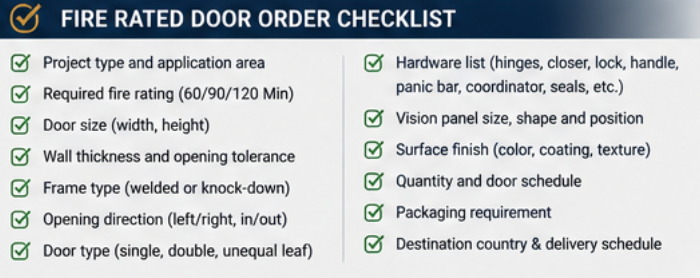
What Buyers Should Prepare Before Ordering
Conclusion: Avoiding These Mistakes Helps Reduce Project Risk
When buying fire rated doors from China, buyers should avoid choosing only by price, ignoring fire rating, providing unclear door size, forgetting opening direction, using unsuitable hardware, skipping surface finish confirmation and accepting weak export packaging. These mistakes may lead to installation issues, project delays, extra cost and poor user experience after delivery.
If you are planning a commercial building, hotel, apartment, hospital, school, factory, warehouse or public facility project, send us your door schedule, drawings, fire rating requirement, hardware list, surface finish and quantity. JIAHUI can help review the details and provide a suitable fire rated door solution for your project.
Need Help Avoiding Fire Rated Door Ordering Mistakes?
Send your project drawings, door schedule, fire rating, opening size, frame type, hardware list and quantity. Our team will help you check the details and provide a suitable project quotation.
Related product and article resources
For procurement comparison and technical evaluation, readers can continue with these related product pages and supporting articles.
- Products
- Product catalog
- Contact the sales team
- Contact us
- 120 Minute Fire Rated Steel Doors With Frame For Industrial Buildings
- 60 Min vs 90 Min vs 120 Min Fire Rated Doors: Key Differences
- 90 Minute Fire Rated Steel Door Supplier For Commercial Building Projects
- Bulk Fire Rated Door Sets From China For Hotel And Apartment Developers