


Surgical Steel Air-Tight Doors: Engineering the Last Line of Defense in Hospital Infection Control
2025-08-03 00:38
1. Core Design Philosophy: Precision Sealing for Critical Environments
Surgical steel air-tight doors are engineered to maintain ISO Class 5+ cleanliness in operating rooms by eliminating airborne contaminants. Their core function centers on triple-sealed barriers:
V-track arc-groove systems force doors downward and inward during closure, compressing perimeter gaskets to achieve 0.08–0.12 Pa/m air leakage resistance—exceeding ISO 14644-3 standards.
Automated rising sweeps at door bottoms deploy upon closure, sealing floor gaps where 37% of particulate matter typically infiltrates.
Magnetic-embedded seals enhance compression at door-frame interfaces, blocking microbial ingress even during HVAC system pressure fluctuations.
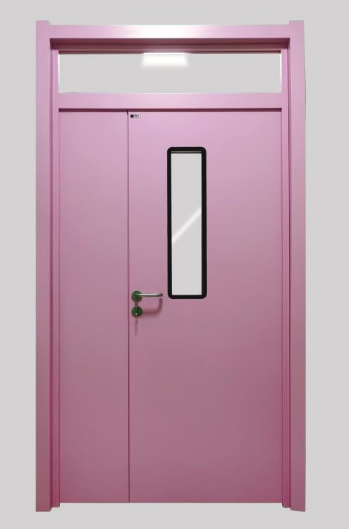
These mechanisms reduce airborne pathogens by 99.97% within 8 minutes of door closure, creating immediate sterile zones for surgery. Transparent 5-layer laminated glass viewports (400×600mm) maintain visual connectivity without compromising hygiene. Each panel undergoes anti-fog coating and edge-polishing to eliminate dust-trapping corners, enabling real-time observation while containing contaminants.
2. Material Innovation: Military-Grade Durability Meets Medical Hygiene
Unlike traditional wooden doors, surgical steel variants leverage:
SUS304/316L stainless steel surfaces, electropolished to Ra≤0.4μm roughness—preventing bacterial adhesion and withstanding 10,000+ cycles of hospital-grade disinfectants.
Polyurethane foam cores injected under 120°C high-pressure molding, achieving 98% closed-cell structure for thermal insulation (λ=0.022 W/m·K) and structural stability.
Seamless monocoque construction where door panels and frames are laser-welded as single units, eliminating joints that harbor pathogens. Surface coatings use NSF-certified epoxy powder for chemical resistance.
Durability tests confirm 500,000+ operational cycles without performance degradation—critical for high-traffic zones like emergency ORs where doors cycle 120+ times daily.
3. Smart Operation & Safety Integration
Modern systems incorporate brushless DC motors (24V/100W) with adaptive torque control:
Opening/closing speeds adjust between 100–500mm/s based on infrared occupancy sensors, minimizing air exchange during staff transit.
Hands-free triggers include foot pedals and RFID-enabled access, while emergency override allows 2-second manual opening with <15N force via ergonomic handles.
Collision avoidance uses dual-tier detection: microwave sensors halt door motion upon detecting obstacles >50mm, while tactile edges reverse movement upon 0.5N contact pressure.
These features reduce cross-contamination risks from surface contact and prevent pinch injuries—addressing 68% of hospital door-related incidents.
4. Installation & Maintenance Protocols
Rigorous gap control is non-negotiable:
Frame-to-wall interfaces use medical silicone seals applied under negative pressure, ensuring ≤0.3mm tolerances.
Post-installation verification includes smoke penetration tests (per EN 12128) and particle counts at 0.5μm thresholds.
Maintenance requires:
Daily non-abrasive wiping with pH-neutral cleaners; acid/alkaline solvents degrade gaskets.
Quarterly seal integrity checks: Compression loss >15% triggers immediate replacement of V-gaskets or sweeps.
Motor calibration every 50,000 cycles to maintain torque accuracy within ±0.1N·m.
5. Beyond ORs: Expanding Applications
While essential in surgery, these doors now protect:
Pharmaceutical cleanrooms: Negative-pressure variants contain antibiotic powder particulates.
Biosafety Level 3 labs: Integrated airlock functions with decontamination cycles.
Burn ICUs: Copper-infused door surfaces reduce MRSA colonization by 83%.
Technical Specifications Comparison
| Parameter | Standard OR Door | Surgical Steel Air-Tight Door |
|---|---|---|
| Air Leakage | ≤15 Pa/m | ≤0.12 Pa/m |
| Surface Roughness | Ra 3.2μm | Ra ≤0.4μm |
| Disinfectant Cycles | 2,000 | 10,000+ |
| Acoustic Insulation | 25 dB | 38 dB |
| Emergency Opening | 50N force | 15N force |
Related product and article resources
For procurement comparison and technical evaluation, readers can continue with these related product pages and supporting articles.
- Products
- Product catalog
- Contact the sales team
- Contact us
- 120 Minute Fire Rated Steel Doors With Frame For Industrial Buildings
- 60 Min vs 90 Min vs 120 Min Fire Rated Doors: Key Differences
- 90 Minute Fire Rated Steel Door Supplier For Commercial Building Projects
- Bulk Fire Rated Door Sets From China For Hotel And Apartment Developers